Questions homeowners ask before going solar
Solar panel and battery storage FAQs
How much does solar panel installation cost in Los Angeles?
The price depends on system size, the roof, electrical service, equipment, permits and whether you add a battery. A simple rooftop-only system has a different budget than solar plus storage, an electrical panel upgrade or a concurrent reroof. We review your usage and site conditions before providing a written scope rather than quoting one flat price for every house.
How many solar panels do I need for my home?
Panel count depends on annual electricity use in kWh, panel wattage, available roof area, shading, roof orientation and your goals. We review roughly 12 months of utility usage and any planned additions such as an EV, electric water heater or heat pump. A roof layout and production estimate provide a better answer than square footage alone.
Can I install solar panels without a battery?
Yes. A grid-connected solar system can generate electricity during daylight without a battery. Battery storage is optional for many projects, but it may be useful for evening energy use or backup power. Your utility rules and the equipment design determine how the system operates.
Will solar panels work during a power outage?
Ordinary grid-tied solar systems shut down during an outage for utility-worker safety. Keeping selected circuits powered requires an approved backup-capable inverter, battery or other permitted backup configuration with the correct isolation equipment. Solar panels by themselves do not guarantee outage power.
What can a home battery actually back up?
Backup depends on usable battery capacity, inverter output, starting loads and whether you choose a critical-loads panel or a whole-home arrangement. Refrigeration, internet, lighting and some outlets may be prioritized. Large air conditioners, electric ranges and EV charging can substantially increase required capacity. We discuss the exact loads before proposing a configuration.
Can you add a battery to an existing solar system?
Sometimes. Compatibility depends on the existing inverter, panel layout, age of equipment, electrical service and utility interconnection rules. A site assessment establishes whether an AC-coupled or other approved configuration is workable and what changes will be needed.
Do I need to replace my roof before installing solar?
Not always. But solar is intended to remain in place for years, so worn shingles, active leaks, weak decking or near-term reroof plans should be evaluated first. Addressing necessary roofing work before installation can help avoid later labor to remove and reinstall panels.
Do I need an electrical panel upgrade for solar and storage?
Not every home needs one. The answer depends on main-panel condition, busbar and breaker ratings, load calculations, inverter output, battery configuration and code-compliant interconnection options. The installation design will identify whether a panel upgrade or other approved approach is required.
How does LADWP net energy metering work?
LADWP net energy metering uses a meter that tracks electricity supplied from the grid and electricity sent back to it. Eligible excess generation may create billing credits under LADWP rules. Those credits are not the same as cash, and certain utility charges and taxes may remain payable. The current utility tariff and interconnection approval control the details.
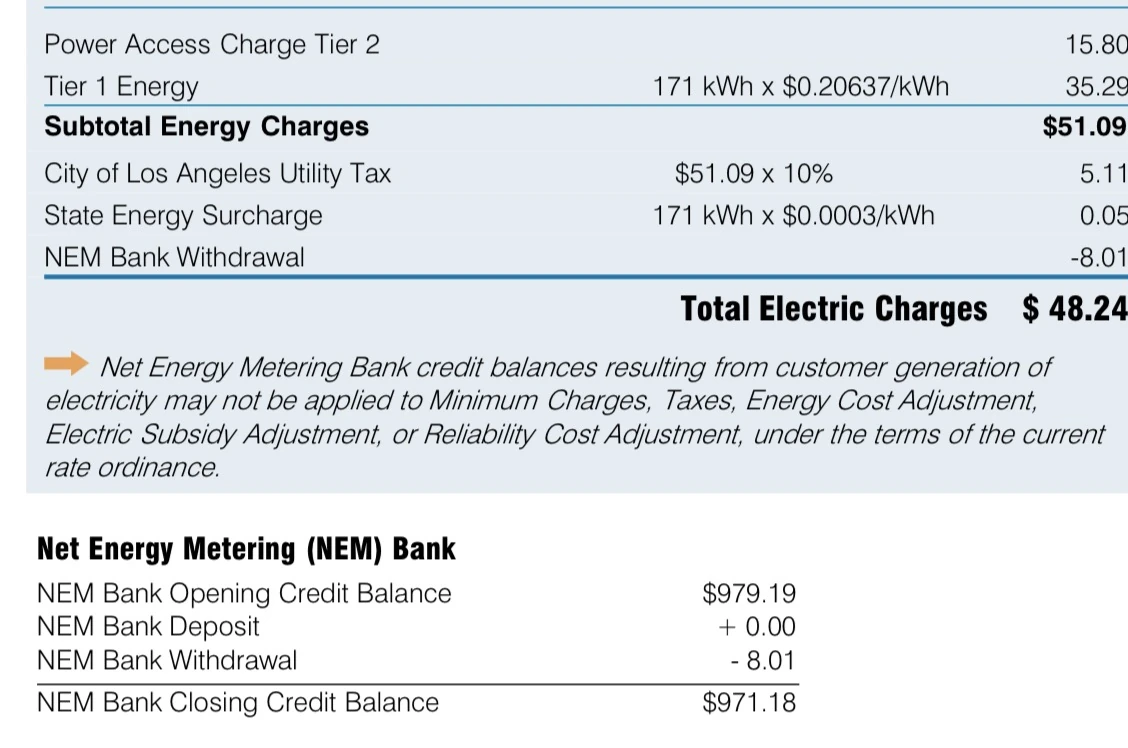
What does the $971.18 LADWP solar credit on this page mean?
The example is a 2023 LADWP statement showing a $971.18 closing balance in its NEM credit bank. The same statement shows 171 kWh used in the billing period and $48.24 in electric charges. It is a historical billing example, not a prediction of your credit, savings, usage or future bill.
Does California NEM 3.0 apply to LADWP customers?
California’s investor-owned-utility Net Billing Tariff is different from LADWP’s municipal-utility rules. LADWP customers should review LADWP’s own NEM and interconnection terms. SCE customers have separate tariff rules. We confirm the utility serving the property rather than treating every Los Angeles address the same.
Are there solar or battery incentives in 2026?
The federal Residential Clean Energy Credit for new residential solar and battery expenditures ended after December 31, 2025. Some qualifying LADWP customers may have access to Self-Generation Incentive Program assistance, subject to current program terms, income and other eligibility rules, and remaining funds. We do not assume any homeowner qualifies until the program is checked.
Do you handle permits and LADWP interconnection?
The project scope addresses applicable permits, inspections and utility interconnection steps, with trade-specific work performed by appropriately licensed parties where required. Approval requirements depend on the utility, jurisdiction, system capacity and whether storage or service upgrades are involved. Equipment cannot be operated in parallel with the grid until the utility authorizes it.
How long does residential solar installation take?
On-site installation is often only one part of the schedule. Roof repairs, design, equipment availability, city permitting, inspections and utility approval can take longer than the physical panel installation. We explain the planned phases and identify dependencies before work begins.
Can I combine solar installation with a new roof?
Yes. Coordinating roofing and solar design together can improve placement of roof penetrations, flashing and equipment while reducing the chance of removing panels for a near-term reroof. See our roofing service page for more information about shingle and reroof options.
Do solar panels need regular maintenance?
Solar equipment generally has limited routine maintenance, but homeowners should periodically review monitoring data, check for new shading or visible damage and arrange qualified service if production drops unexpectedly. Roof safety and electrical work should be left to appropriate professionals.
Can solar help with higher electricity use from an EV or an ADU?
A planned EV charger, accessory dwelling unit or additional HVAC load can change the size and economics of a solar system. The design should account for reasonably expected future electricity use as well as current bills, utility requirements and available roof area.
Can solar and a battery eliminate my electric bill?
Not necessarily. Solar may reduce purchased electricity and may produce NEM credits, but many accounts still have fixed charges, taxes or periods of net consumption. Battery storage may improve self-consumption and backup capability but does not guarantee a zero-dollar bill. We avoid promises that depend on weather, future rates or household behavior.